


Picking the best trekking poles or hiking staffs comes down to matching the gear to your trail and your body. Choosing the best trekking poles or hiking staffs for your adventure can significantly enhance your hiking experience by providing stability, balance, and support, especially on rugged terrain. While both serve similar purposes, they have key differences:
Design and Structure:
- Trekking Poles: Trekking poles typically consist of two separate poles, one for each hand. They usually feature adjustable length settings, collapsible or telescoping designs, and wrist straps for securing the poles to your hands.
- Hiking Staffs: Hiking staffs, also known as walking staffs or hiking sticks, are usually single poles held with both hands. They may have a more traditional or natural appearance, resembling a walking stick.
Number:
- Trekking Poles: Sold as a pair, with one pole for each hand.
- Hiking Staffs: Typically sold as single units.
Length:
- Trekking Poles: Usually adjustable in length, allowing you to customize the height based on your preference and the terrain you’re hiking on.
- Hiking Staffs: Generally come in fixed lengths, although some may offer limited adjustability.
Grip:
- Trekking Poles: Often feature ergonomic grips made from materials like rubber, foam, or cork, providing a comfortable and secure hold, even when wet.
- Hiking Staffs: May have simpler grip designs and may lack the ergonomic features found on trekking poles.
Tip:
- Trekking Poles: Typically have carbide or steel tips for traction on various surfaces, with some models featuring rubber tips for use on hard surfaces or indoors.
- Hiking Staffs: Often have a single tip made from metal, rubber, or another durable material, with the tip being reinforced or featuring a spike for better traction on uneven terrain.
Usage:
- Trekking Poles: Commonly used by hikers, backpackers, and trail runners to provide stability, reduce strain on the knees and ankles, and improve balance, particularly on steep or uneven terrain.
- Hiking Staffs: Often favored by individuals seeking a more traditional hiking experience or those who prefer the simplicity and elegance of a single walking aid. They can also be useful for individuals with mobility issues or those who need extra support while hiking.
Our Picks for the Best Trekking Poles or Hiking Staffs in 2026
To make the lists products easy to compare, They are listed from by pricing. Having the most affordable option at the top and working up to the most expensive.
Black Diamond Trail Back Trekking Pole- Best Overall

Specs:
– Price: $99.95
– Weight: 1 lb. 2 oz.
– Shaft: Aluminum
– Grip: EVA Foam
– Adjustable Length: 100–140 cm
– locking: Flick Lock / External Lever Lock
The Black Diamond Trail Back was the choice for the starting pick on this list and for reason. Not only is this the cheapest option anywhere but because it dose earn the “best overall” label without having to cut corners to reach a cheap price. At $99.95 it is the most affordable pole on this list, it’s a pole we would recommend to most hikes regardless of the level of experience. Its not a pole with a cork grip, it is not made of carbon fiber, it is not eye catching for someone who loves gear specs but it has a very reliable locking system. It has a lovely and comfortable grip, it holds up really well under real body weight across terrains, this is a pole that most people actually need for trekking poles.
A feature for the trail back is it comes with dual density EVA foam grips, which have an extension section that sits below the main grip. It allows you to shift your hand position when going uphill without being concerned with stopping and readjust the pole’s length. The poles have the Flick Lock adjustment system which is a feather that stands out. Multiple people who reviewed this product switched because of the trouble from previous poles that kept slipping or collapsing under stress and load. The Trail back also came with a trekking and snow basket, this is nice a poles later in this list cost twice as much and does not include both. The reviews that used it vary from range 5’2 to 6’3 and the hikes were from heavy load and long range hike to light easy hikes. All saying they had a positive experience using this pole.
There are a few limitations with this pole. The height markers on the shaft do tend to rub off with time, multiple users complained about this. One reviewer even scratched new marking onto the pole manually as the original faded. The product also dose not come with any rubber tips. This causes issues if you plan on using this pole on pavement or broad walk. The tips they come with, Carbide tips do great on dirt and trails but do make loud screeching sounds on hard surfaces. This issue is not a serious issue as the rubber tips covers can be easily bought and are not expensive at all. They are worth buying separately if you want to start using this for urban or hikes with mix surfaces. The locking mechanism will require you to manually tighten it over time, keep in mind that this is not a failure but more like regular maintenance. One outlier that should be mentioned is a single review mentioned how the telescoping section disconnected when the pole was pulled from deep muddy ground in wet condition. This is a one of case but worth mentioning to keep in mind when considering this product.
The Trail back doesn’t try and stand out in the lightest pole section, most premium material or even the most packable pole But that’s the point. Its made to be dependable for the widest range of hikers that has constant reviews to back up the promise.
REI Co-op Traverse Trekking Poles — Best Mid Range Pick
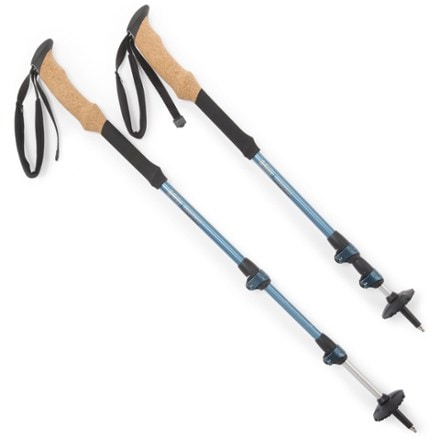
Specs:
– Price: $119.00
– Weight (Pair): 1 lb. 2.5 oz. / 1 lb. 3.5 oz.
– Shaft: 7001 Aluminum
– Grip: Cork
– Adjustable Length: 95–120 cm / 105–140 cm
The REI Co-op Traverse is a pole that sits in a sweet spot compared to most trekking poles. It’s not the cheapest option for buying a trekking pole but its also not a massive investment and asking you to pay $170 and above for the expensive poles. It has frequent sales and is a good entry point if you are someone who likes to hike and cares about the quality but don’t plan to pay for expensive pricing that comes with MSR or Black Diamond. A review brought up a massive point that separates this product from the cheaper options: It has metal locking levers instead of plastic. On something you end up putting your full weight on. Small differences like metal or plastic levers are what secures safety of the pole not giving through. This distinction matters quite a lot to what most people think.
The Traverse uses 7001 aluminum which is a premium material used instead of the standard material, it also pairs with a foam extension and cork grip. This is a combination for a grip that you usually find on products that cost twice as much as this. It also has a locking mechanism that can be used anywhere rather than having to need a hex key to change its size. This is a practical advantage when you are on a hike. You can dial in the tension whenever without having to worry about carrying a separate tool in your kit. One review for this product used this product for 10 years and traversed thousands of miles before buying an updated version and was quite satisfied. This also shows you that this product can easily be a long term investment as it lasts as long as a trekking pole on the market. Multiple other reviews for this product mentioned that it was very easy to carry in luggage for trips as it can collapse into a compact 23.5 inches.
There are two concerns with Traverse that are worth knowing. As its a unisex design, the grip can be a bit large. A user mentioned how with medium sized hands they found the cork way to big and caused it to be uncomfortable when using, leading them to exchange it for another trekking pole.It is highly recommended that you try this product in store before buying it if you have smaller hands. To save you the trouble of dealing with a troubling grip. Now the second issue with the Traverse are that a reviewer bent three out of his four poles while doing a winter hike in quite deep snow, the trekking poles were supporting approximately 180 pounds of load. When the broken poles were brought to REI, the store had this classified as just normal tear and wear causing a refusal on their warranty. It is to be noted that they were told by the manager that they would not trust REI brand poles for those conditions. It’s better not to rely the REI poles for hikes in extreme conditions. Its better to invest in a Black Diamond or Leki instead if you plan to hike through demanding conditions. This is worth thinking about seriously if you planned to use these to hike in heavy winter or hike on heavy loads.
For normal hike or seasonal hike, the Traverse is worth it for its price. The metal levers, cork grip, premium aluminum shaft and the ability to adjust it without a tool is all stuff you get for a price range above $119. A reviewer has used it for a decade in the past and it held up quite well. That being said, this is a trail pole and not for very cold weather mountaineering. Push it past extreme weather and it’s not worth buying. If you plan to hike in spring and establish trails. It is a solid choice but if you plan to push through winter use and want something that can take serious abuse, It’s recommended to consider other products.
Black Diamond Pursuit – Best for regular hikers

Specs:
– Price: $169.95
– Weight (Pair): S/M: 1 lb. 0.4 oz. / M/L: 1 lb. 1.6 oz.
– Shaft: 7000-Series Aluminum
– Grip: Cork
– Adjustable Length: S/M: 100–125 cm / M/L: 100–140 cm
– Locking: Flick Lock+ / External Lever Lock
The Black Diamond Pursuit is a pole that is on this list for someone who is more than a casual hiker, someone that wants gear to keep up with their rigorous hiking. At $169.95, you are spending a lot of money and the price gap from the Trail back and Traverse needs to be justified. The Pursuit not only justifies this price gap by using high spec material but also nice features. The Pursuits values can be seen by people who hike regularly enough to start noticing the effects and differences between a cork and foam grip. Someone who cares about the looking system staying dialed and locked for thousands and thousands of miles. A pole that provides consistent use rather than hoping the poles survive the hike.
The stand out feature that he Pursuit has that catches reviews eye is not their 7000-series aluminum shaft or their cork grip. Its the in build 1.5 mm hex hidden inside the pole shaft. This has come up in any user positive review as it solves quite a troublesome problem. The Flick Lock lever that is used normally losses over times, this creates a problem if you don’t have a tool on hand as a hiker. With this issue, on hikes the hiker has to wait till they get of the hike and get back to fix it, as otherwise they have to deal with slipping pole. The Pursuit solves this problem entirely as it uses a adjustable tool directly in the pole. The Bloom grip extension is also made from algae-infused foam. This added detail helps provide more hand positions for steep ascent and you don’t have to concern yourself with readjusting the pole length. The reviews for this product have take these to the Alps, Scottish Highlands and 40 mile backpacking tips. They consistently report the locking system holding and the pole being reliable under serious load. The S/M version for this comes in around 1lb per pair, that also makes this lighter than both the Trail Back and the Traverse.
The Pursuit has only two recurring issues in the reviews we evaluated and were worth taking seriously. The first issue is that the Flicklock level can snag on hikes with brush, clothing or snow and can cause the pole to accidentally open up mid hike. A review even decided to return it back after 100 miles out of the concern of using the pole in technical terrain. This was not a universal complaint and it is specific but is worth noting. The second issue that came up was the issue with side. The pole comes in S/M and M/L, and this can massively affect your grip size and max pole length, so not only the pole fit. If you are over 5’6, it is almost always recommended you pick a M/L for the complete 100 to 140 cm adjustment range. Several reviews that did not know this ended up getting caught off guard when they bought the product. When you buy this pole, it also requires manually adjustment before you first start using it. You can use the built-in hex tool handle, new users and at least one review ended up having their pole collapse under load before they realized the clamps need dialing right as it bought out the box. If you are aware of these small things, the pole doesn’t really have any negatives issues except for the few complains with the level snagging on clothing or snow here and there.
The pursuit does earn its price for hikers who are serious and plan to put tons of miles on their gear. The cork grip, built-in adjustment tool, the higher quality material used and the lighter weight compared to the cheeper poles on our list all are testament to how it all adds up providing the user with a great pole to use. The FlickLock snagging it the only main concern but is quite manageable. Its only a issue on technical terrain with heavy snow or brush. For a regular hiker who doing serious hike in the three season use. This is the sweet spot that ticks all your boxes. If you plan to hike more casually or just occasionally. The previous products mentioned such as Trail back and Traverse will do you just as well and cost you less. If you plan on pushing into even more rigorous territory or need a pole with more packable options. The MSR DynaLock or the Alpine Carbon Cork is the best step.
MSR DynaLock Ascent Carbon Backcountry Poles — Best Packable / Backcountry Pick

Specs:
– Price: $189.95
– Weight (Pair): 1 lb. 1 oz. / 1 lb. 2 oz.
– Shaft: Kevlar-Reinforced Carbon Fiber
– Grip: EVA Foam
– Adjustable Length: 100–120 cm / 120–140 cm
– Locking: Flick Lock+ / External Lever Lock
The MSR Dynalock Ascent Carbon is the most specialized on pole on this list. while all the other poles focus mainly on helping the hiker through the hike at this price range. This pole tries to be more with it being designed to disappear when not in use. turning into 14.25 inches when its folded, it can be small enough to conveniently be strapped onto a running vest or to be put in a daypack. This is a feature that no conventual telescoping pole can give you. This also makes it good if you want to do more than just hiking. It the best choice for trail runners, fast packers and split boarders. If you want to use a pole for certain parts of the hike and prefer to not use a pole for other parts without having to worry about carrying a annoying pole. This is the product you should consider. If you plan on hiking on established trails and want to use a pole throughout then the trail back or pursuit might be more up your allay.
The Kevlar-reinforced carbon body of the DynaLock has been tested in situations that would cause most trekking poles to fail — reviewers have used them on Denali, Aconcagua and Lhotse, the fourth highest mountain in the world, as well as throughout the Greenland Ice Cap and on Svalbard expeditions. These aren’t just ordinary weekend reviews — they are serious mountaineers subjecting their gear to truly harsh conditions, and the poles have proven themselves. The tool-free tensioning system is a practical improvement on Black Diamond’s need for a hex key since it allows you to adjust the clamping force on the go without having to carry an extra tool. Both a trekking basket and a powder basket are included from the start, providing real four-season versatility. At 1 lb. 1 oz. for the pair, it is one of the lightest models on this list even though it has the Kevlar-reinforced construction. Many reviewers point out that the poles can be deployed quickly even when wearing heavy gloves in temperatures below freezing — a factor that is more important than it may at first seem when you’re on a mountain and need your poles urgently.
The DynaLock does have a rather steep learning curve and it’s important to be honest about this. The push-button locking mechanism , the feature that enables the pole to fold so compactly, operates in a completely different way from the FlickLock systems found on all the other poles in this list. Several reviewers say that it took them a while to get used to it, and in one case a reviewer ended up giving up altogether and returned the product without ever managing to get the system to work correctly. This is not a defect but rather reflects the fact that it is a genuinely different design which requires you to read the instructions before using it for the first time, rather than something you pick up on instinct while out on the trail. The snow baskets are also quite hard to attach — many reviewers state that a good deal of force is needed to push them on, and one reviewer’s son completely stopped trying. Furthermore, two reviewers reported that the locking mechanism itself failed after between six and twelve months of regular use, which is a real issue when considering the price of the product. It should be pointed out that two of the most positive reviews in the group came from MSR ambassadors who disclosed their connection with the brand — their qualifications are legitimate but their viewpoint is not entirely independent.
The DynaLock is priced at $189.95 and therefore occupies a rather interesting spot on this list since, although it is the most specialized pole listed, it is in fact less expensive than the Alpine Carbon Cork. One can better understand why it has this price if one considers what one is actually paying for: it is not the most comfortable grip, not the longest adjustment range, nor the stiffest pole suitable for ordinary hiking — rather, it is the capability to go to places and carry out activities that no other pole on this list can do. Therefore, it is the appropriate choice for trail runners, fast packers, split boarders, or anyone whose sport involves using poles that have to disappear into a pack when they are not needed. For everybody else, the Trail Back, the Traverse, or the Pursuit will offer greater practical value at a lower cost. There is a real learning curve associated with the locking mechanism so it’s advisable to take the time to get used to it at home before your first trip, not on the mountain.
Black Diamond Alpine Carbon Cork Trekking Poles — Best Upgrade Pick

Specs:
– Price: $229.95
– Weight (Pair): 1 lb. 1.1 oz.
– Shaft: Carbon Fiber
– Grip: Cork
– Adjustable Length: 61–130 cm
– Locking: Dual FlickLock Pro / External Lever Lock
The Black Diamond Alpine Carbon Cork is the most costly of the poles listed, and the reason for paying $229.95 for trekking poles has nothing to do with features; it’s all about time. The group of reviewers for these poles is different from any of the others on this list: it includes people who have used the same pair for four, five, and six years over thousands of miles, one reviewer who used them every day on an Alaskan ranch for four years including crossings of quicksand, and a number of hikers who have either worn out their poles or lost them and have then immediately purchased a new pair without looking at any other option. You’re not getting the lightest pole or the most packable one. You’re buying the pair that you’ll still be using when you’ve been hiking for ten years.
The Alpine Carbon Cork is in fact the lightest pole on the list, weighing 1 lb. 1.1 oz. per pair, a remarkable accomplishment for a carbon fiber pole that has been used in serious mountaineering approaches, ski patrol work, alpine touring, and PCT long-distance hikes. Compared to aluminum, the carbon shaft does a better job of absorbing vibration, a feature that becomes important on days when fatigue builds up. The cork grip adjusts to the shape of your hand over time, while the rubber extension under the main grip offers extra hand positions when climbing on steep slopes. The only feature on any of the poles in this list is the ski-compatible ferrules, which are designed to take 100mm powder baskets and so these poles can truly be used as ski poles with the appropriate accessories. Black Diamond also offers individual replacement parts; one user repaired their pair after having travelled over 2,000 miles rather than replacing the poles altogether, a testament both to the brand’s after-sales support and to the poles’ long-term repairability.
The FlickLock mechanism is the most frequently mentioned drawback in the 363 reviews of the Alpine Carbon Cork — a problem that has persisted through several generations of the pole. During use the locking sleeve can become dislodged and to correct this an Allen wrench is needed, even though few people carry one when on the trail. Earlier versions of this pole had used a Phillips screw or a coin-adjustable slot — a design that many long-term users have specifically favored and a number of reviewers are honestly annoyed that Black Diamond has moved away from it. There’s also a rather unusual warning relating to cork grips which two reviewers found out the hard way: animals are drawn to sweaty cork left overnight on backcountry trips. In one instance a reviewer had their grips ruined by a mouse over the course of a single night of backpacking. It seems almost funny until it happens to you, if you’re carrying out multi-day backcountry trips then you should keep your poles inside your tent or shelter overnight. Lastly, powder baskets are not included with the pole when it’s sold for $229; they have to be bought separately, which is disappointing at this price level since some of the cheaper poles on this list come with both types of basket.
The Alpine Carbon Cork is the most difficult of all the poles to recommend without hesitation — it only becomes clear why it’s a good choice after a long period of use. Although it costs $229 up front, hikers who have owned the poles for six years and have covered thousands of miles will say that they’ve actually paid less per mile than someone who had bought three cheaper pairs over the same period. The Flick Lock sleeve problem is genuine and will eventually impact most users — learning how to tighten it correctly and taking a small Allen wrench with you on longer trips is simply part of the experience of owning these poles. For a serious hiker who hikes a consistent number of miles each year and wants to buy once and then be done with it, this is the most honest recommendation at the top of the list. But if you’re still getting used to hiking or only go hiking occasionally.
Ultimately, the choice between trekking poles and hiking staffs depends on personal preference, hiking style, and specific needs. Some hikers may prefer the versatility and adjustability of trekking poles, while others may opt for the simplicity and elegance of hiking staffs.
Frequently Asked Question
Do I need one pole or two?
Two, in most cases. A pair of trekking poles gives you a natural walking rhythm and lets you push off with both arms, which is what actually takes weight off your knees, hips, and lower back on long descents. A single staff is fine for casual, flat-terrain walks or if you’re managing a specific injury, but for real trail miles, two poles will serve you better.
Are trekking poles worth it for a short days hike or just long backpacking trips?
The best trekking poles or hiking staffs earn their keep on nearly every outing. They’re worth it for both, honestly. Even a 3-4 mile day hike with any real elevation change benefits from poles — they reduce the pounding on your knees on the way down and give you extra traction on loose or wet sections. You’ll notice the difference most on longer trips, but there’s no hike too short to bring them.
what’s the major difference between carbon and aluminum poles?
Material is one of the biggest factors that separates the best trekking poles or hiking staffs from mediocre ones. Weight and durability, mostly. Carbon poles are lighter and dampen trail vibration better, which is nice on long days, but they can shatter under a hard sideways impact instead of bending like aluminum does. Aluminum poles are heavier but will bend before they break, which makes them the safer, more forgiving choice if you’re scrambling or hiking off-trail.
Can a hiking staff replace trekking poles?
Not always — the best trekking poles or hiking staffs each shine in different situations. For some hikers, yes. If you’re walking mostly flat or gently rolling terrain, a single staff gives you enough stability without the extra cost and weight of a second pole. But on steep, technical, or loaded-pack terrain, two poles distribute your effort and balance far more evenly, so we wouldn’t recommend a staff as a full replacement for serious trekking.
Final thoughts
Whichever direction you lean, the best trekking poles or hiking staffs are the ones that match how and where you actually hike. There’s no single right answer here — it comes down to the terrain you hike most and how much you value adjustability versus simplicity. Start with the Traverse or Trailmade if you’re not sure yet; you can always upgrade once you know how many miles you’re really putting in. If you’re gearing up for a bigger trip this season, check out our winter hiking guide for more on building out the rest of your kit.


